
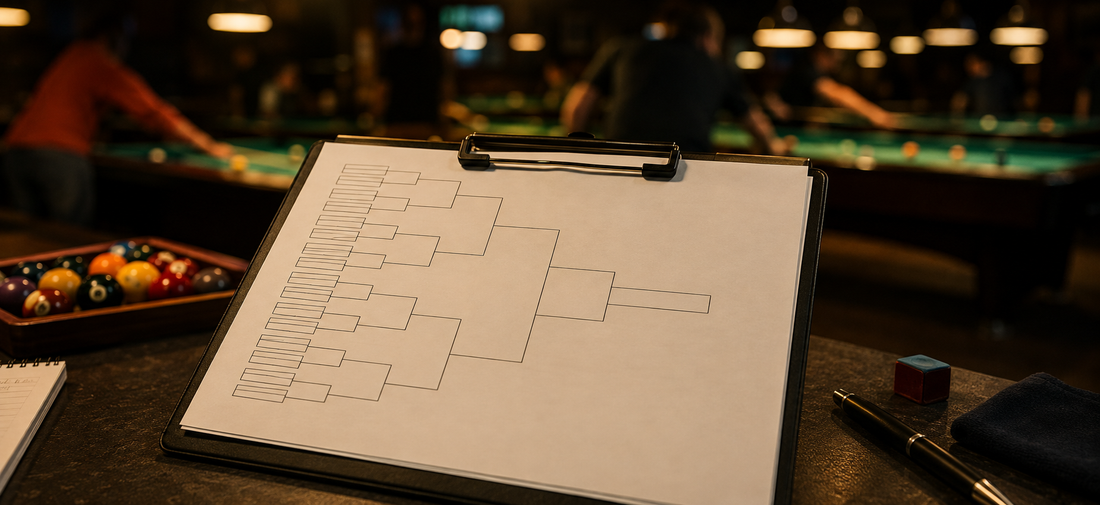
If you're new to running tournaments, one question comes up before the first ball ever gets racked: "What format should we run?" Whether it's a weekly bar tournament with 8 players or a regional event with 60, the bracket format you pick decides how long your night runs, how happy your players are, and whether the best player in the room actually wins.
There's no single "correct" format. There's only the right format for your field size, your time, and your table count. This guide walks through every bracket format you're likely to run into in the pool and billiards world, in plain language, so you can pick with confidence instead of guessing.
First, the Three Questions That Decide Your Format
Before you even look at the list below, answer these three things about your event:
- How many players, and how many tables? A 40-player field on 3 tables needs a different format than 12 players on 6 tables.
- How much time do you actually have? A weeknight league needs to end by a certain hour. A weekend regional can run long.
- Do you want everyone to get their money's worth, or do you want a fast, decisive winner? Some formats guarantee everyone multiple games. Others can send a player home after one loss.
Keep those three answers in mind as you read — they'll point you to the right format faster than anything else.
Single Elimination
How it works: Win and you move on. Lose once and you're out. Players are placed on a bracket, and each round cuts the field roughly in half until one player remains.
Best for: Large fields, limited time, or events where you need a clean, fast finish — think a one-night bar tournament with 16+ players and only a handful of tables.
Why directors like it: It's the easiest format to explain, the easiest to run on a whiteboard or printed sheet, and it finishes fast. A 16-player single elimination bracket only needs 15 matches total.
The tradeoff: One bad game and a player's night is over, sometimes minutes after they walked in the door. Players who paid an entry fee for one loss and a long drive home tend to grumble. It's also more vulnerable to an upset knocking out your best player early, with no way back for them.
Example (8 players):
Round 1: A vs A′, B vs B′, C vs C′, D vs D′ → Winners: A, B, C′, D′ (the other four are out)
Round 2 (semifinals): A vs B, C′ vs D′ → Winners: A, D′
Final: A vs D′ → Champion: A
One loss, at any point, and that player is done for the night — that's the whole format in a nutshell.

Double Elimination
How it works: Same start as single elimination, but losing once doesn't send you home. Your first loss drops you into the loser's bracket, where you keep playing. Lose a second time, and now you're out. The winner's bracket champion and the loser's bracket champion meet in the final.
Best for: Most competitive pool tournaments. It's the standard for a reason — it rewards players for showing up to play, not just for surviving one unlucky rack.
Why directors like it: It's fairer. A player having an off game early doesn't end their whole tournament, and the eventual winner has usually proven themselves twice. This is the format most serious players expect to see.
The tradeoff: It takes longer and needs more tables and more matches than single elimination — often close to double. If your winner's bracket finalist has zero losses and your loser's bracket finalist has one, true double elimination requires the winner's side player to be beaten twice in the final to lose the whole event (a "bracket reset"). That can mean two full matches back-to-back late at night, which is why a lot of directors modify it (see below).
Example (4 players — A, B, C, D):
Winner's Bracket Round 1: A vs B, C vs D → Say A and C win. B and D drop to the loser's bracket, each with 1 loss.
Loser's Bracket Round 1: B vs D → Say B wins. D is eliminated (2 losses). B advances with 1 loss.
Winner's Bracket Final: A vs C → Say A wins. C drops to the loser's bracket with 1 loss. A has 0 losses and waits for the Grand Final.
Loser's Bracket Final: B vs C → Say C wins. B is eliminated (2 losses). C advances to the Grand Final with 1 loss.
Grand Final: A (0 losses) vs C (1 loss)
- If A wins → tournament over, A is champion.
- If C wins → both players now have 1 loss each, so a bracket reset is played: one more full match between A and C to decide the champion.
That reset match is the part directors most often trim off — which is exactly what Modified Double Elimination does.
Modified Double Elimination
How it works: It's double elimination with the long tail trimmed off. The most common version: whoever comes out of the winner's bracket undefeated only needs to win one final match to take the whole tournament — no bracket reset, even if the loser's bracket player beats them once. Some versions also switch to single elimination for just the final few rounds to save time.
Best for: Local and league-level tournaments where you want the fairness of double elimination without keeping everyone at the pool hall until 2 a.m.
Why directors like it: This is genuinely the most common format at the weekly and regional level. It keeps the "second chance" players love, but caps how long the finals can drag on. A lot of directors run this without even realizing there's an official name for it — if your finals only go one set instead of a full reset, you're already running modified double elimination.
The tradeoff: Purists will point out the winner's bracket player technically doesn't get a "true" second chance the way the loser's bracket player did. In practice, almost nobody in your room will notice or care.
Example: Take the exact same 4-player scenario from the Double Elimination example above, right up to the Grand Final: A (0 losses) vs C (1 loss).
- If A wins → A is champion, same as true double elimination.
- If C wins → under Modified Double Elimination, C is declared champion immediately. There's no reset match — one Grand Final game decides it, win or lose, for both players.
That single change is what shortens the whole tournament without changing anything about how earlier rounds are played.
Round Robin
How it works: No elimination at all. Every player plays every other player once (or twice, in a double round robin). Standings are based on total wins, and the top finishers are ranked or advance to a final playoff.
Best for: Small fields — think 4 to 8 players — or weekly league play where everyone is expected to play a full slate of matches over several weeks.
Why directors like it: It's the fairest format there is. Nobody goes home after one bad rack, and by the end, every player has a genuine, complete résumé of results. It's ideal for handicapped leagues like Wednesday night play, where consistency over many matches matters more than one hot night.
The tradeoff: It doesn't scale. A 16-player round robin needs 120 matches to make sure everyone plays everyone — completely impractical for a single-day event. Past 8 players, round robin is really a multi-week league format, not a one-night tournament format.
Example (4 players — A, B, C, D): Every player plays every other player exactly once — 6 matches total: A vs B, A vs C, A vs D, B vs C, B vs D, C vs D.
Say the results are: A beats B, C, and D (3 wins). B beats C and D (2 wins). C beats D (1 win). D loses all three (0 wins).
Final standings: 1st — A (3-0), 2nd — B (2-1), 3rd — C (1-2), 4th — D (0-3). No one was ever "out" — the standings are simply built from every result.

Round Robin + Bracket (Pool Play)
How it works: A hybrid. Split the field into small groups (pools of 4 to 6), run a round robin inside each group, then take the top finisher (or top two) from each pool into a single or double elimination bracket for the real playoff.
Best for: Medium-sized fields where you want to guarantee everyone a few real matches before anyone goes home, but you still need the event to end at a reasonable hour.
Why directors like it: It solves round robin's biggest weakness. Everyone is guaranteed a handful of matches during pool play, so a $20 entry fee doesn't buy someone a single ten-minute game. Once pools wrap up, the bracket stage still gives you the drama and clean finish of an elimination format.
The tradeoff: More setup work — you need to build pools, decide how many advance, and seed the bracket fairly once pool play ends. Uneven pools (a "group of death" with three strong players in one pool) can also feel unfair if you don't seed carefully.
Example (8 players split into 2 pools of 4):
Pool 1: A, B, C, D play a full round robin (6 matches). Say A finishes 1st, B finishes 2nd. Pool 2: E, F, G, H play a full round robin (6 matches). Say G finishes 1st, H finishes 2nd.
Everyone has now played 3 guaranteed matches, win or lose.
Playoff bracket (top 2 from each pool, cross-seeded): A (Pool 1, 1st) vs H (Pool 2, 2nd), and G (Pool 2, 1st) vs B (Pool 1, 2nd). → Winners meet in the final to decide the champion.
Chip Tournament (Survivor Format)
How it works: Every player buys in with a set number of chips (often handicapped — stronger players start with fewer chips, weaker players with more). Games are single racks, not races. Lose a rack, lose a chip. Win, and you stay at the table to play whoever's next up. Run out of chips, and you're out. Last player standing with chips wins.
Best for: Informal, social, weeknight tournaments where the point is action and playing time, not crowning the most "correct" winner. Very popular for bar and pool hall weeklies.
Why directors like it: It's fast-moving, keeps tables full, and gives even weaker players a real cushion since they start with more chips. Players get to play a lot of racks against a lot of different people in one night rather than sitting around waiting on a bracket.
The tradeoff: Because it's single racks instead of races, luck plays a bigger role than in a traditional bracket. It also tends to reward slower, more deliberate players since it eats up more of the clock per chip lost — something a lot of directors adjust for by giving slower games (like 8-ball) fewer starting chips than faster ones (like 9-ball).
Example (4 players, everyone starts with 3 chips):
Rack 1: A vs B → A wins. B drops to 2 chips. A stays at the table. Rack 2: A vs C (next up) → A wins again. C drops to 2 chips. A stays. Rack 3: A vs D → D wins this time. A drops to 2 chips and rotates off. D stays at the table. Rack 4: D vs B (next up) → B wins. D drops to 2 chips.
Play continues, one rack at a time, with the loser always losing a chip and the winner staying on the table. Once a player's chip count hits zero, they're out. The last player left with any chips remaining wins.
Swiss System
How it works: No one is eliminated. Each round, players are paired against someone with a similar record so far — winners play winners, losers play losers. After a set number of rounds, standings are based on total wins.
Best for: Large fields where round robin isn't practical but you still want everyone to keep playing regardless of an early loss.
Why directors like it: It scales far better than round robin while still giving every player several meaningful matches. Nobody is out after one loss, but the format still sorts out a clear top finisher by the end.
The tradeoff: It's less familiar to casual players and takes more explaining at check-in than a bracket on the wall. It also needs a bit more bookkeeping to pair each round correctly, though most tournament software (including Fargo-linked systems) can do this for you.
Example (4 players — A, B, C, D):
Round 1 (random pairing): A vs B, C vs D → A and C win. Nobody is eliminated.
Round 2 (paired by record — winners play winners, losers play losers): A vs C (both 1-0), B vs D (both 0-1) → Say A wins again and D picks up their first win.
Round 3: A (2-0) vs D (1-1), B (0-2) vs C (1-1)
After all rounds are played, the champion is simply whoever finishes with the best overall record — nobody was ever knocked out along the way.
Ladder Tournament
How it works: Not a single-event bracket at all — a running, ongoing format. Players are ranked on a list ("the ladder"). Anyone can challenge a player ranked above them; win the challenge match and you swap spots on the ladder.
Best for: Ongoing club or league standings over weeks or months, rather than a single tournament night.
Why directors like it: It's low-maintenance and self-sustaining. There's no single big event to organize — players challenge each other on their own schedule, and you just update the list. Great for keeping a pool room's regulars engaged between bigger tournaments.
The tradeoff: It's not a bracket format for crowning a single-day champion, so don't reach for this if you need a winner by the end of the night.
Example: The ladder currently reads 1. A, 2. B, 3. C, 4. D.
D (rank 4) challenges C (rank 3) to a match. D wins. → New ladder: 1. A, 2. B, 3. D, 4. C.
Later, B (rank 2) is challenged by D (now rank 3). B wins and keeps their spot. → Ladder stays: 1. A, 2. B, 3. D, 4. C.
The ladder just keeps shifting like this over weeks or months as challenges happen — there's no "final match" that closes it out.
Skins Format
How it works: Borrowed from golf. Instead of one long match, players compete rack-by-rack (or game-by-game) for a set prize amount attached to each "skin." Win the rack, win the skin. If a rack is tied or pushed, the prize can carry over and stack onto the next rack.
Best for: Casual, prize-driven events and exhibitions where the entertainment value of a big stacked pot matters as much as the win itself.
Why directors like it: It's exciting to watch — a carried-over skin can turn into a big payout on a single rack, which keeps a crowd engaged. It also works well as a side event or added attraction alongside a main bracket.
The tradeoff: It's more of a side-game or exhibition format than a way to determine an overall tournament champion. Most directors run skins as bonus action alongside a "real" bracket, not as the main event.
Example: Each rack is worth $20.
Rack 1: A vs B → tied (a "push"). No skin is won — the $20 carries over. Rack 2: A vs B, now worth $40 → A wins → A takes the $40 pot. Rack 3: A vs B, back to $20 → B wins → B takes the $20.
A player can go a while without winning a rack and then scoop a big stacked pot on a single win — that swing is exactly what keeps a crowd watching.
Two-Stage (Group Play to Single Elimination)
How it works: The field starts in double elimination or round-robin groups to thin out the numbers, then the remaining players are re-seeded into a straightforward single elimination bracket for the finish.
Best for: Larger regional or pro-style events where you want the fairness of extended play early on, but a clean, easy-to-follow finish for the final stretch.
Why directors like it: Spectators and players both benefit — the bracket becomes simple to follow once you hit the single elimination stage, and it avoids the marathon "double elimination final with a bracket reset" that can drag a finals match into a second full set. A lot of touring pro events have shifted toward this exact structure for that reason.
The tradeoff: It's a bigger lift to set up and explain than a straightforward single or double elimination bracket, and it works best with a decent-sized field (24+ players) to justify the extra stage.
Example (16 players):
Stage 1: Split into 4 groups of 4 (A, B, C, D in Group 1; and so on). Each group plays double elimination or round robin down to its own top 2 finishers. That's 8 players total advancing out of the 16.
Stage 2: Those 8 survivors are re-seeded into a fresh single elimination bracket — quarterfinals, semifinals, final — with no losses carried over from Stage 1.
Players get the safety net of Stage 1, and everyone watching gets a clean, easy-to-follow bracket for the part of the night that matters most.
How to Actually Choose
A simple way to think about it: the fewer players and tables you have, the more you should lean toward round robin or modified double elimination. The more players and time pressure you have, the more you should lean toward single elimination or a chip format. If you want the fairest possible result and have the time and tables for it, true double elimination or a round robin + bracket hybrid is worth the extra length.
Don't feel locked into picking just one, either. It's common to run a chip tournament as a casual weeknight event, and save full double elimination for the monthly or seasonal event that actually crowns a champion.
Free Printable Bracket Templates
Once you've picked a format, you still need an actual bracket to run it — something to print, pin on the wall, or fill in as players check in. PrintYourBrackets.com is a solid free resource built exactly for this, and it even has a billiards-specific section:
- Single and double elimination brackets, sized for pool — pre-built brackets from 3 players all the way up to 128, so you're not stuck manually drawing lines for a 27-player field.
- Blind draw or seeded, your choice — every bracket size comes in a blind draw version (players placed randomly) and a seeded version (stronger players kept apart in early rounds). Use blind draw for a casual weeknight, seeded for anything where fair, skill-based matchups matter.
- Round Robin scheduling — their Round Robin Schedule Generator builds out the full match schedule automatically if you're running round robin instead of a bracket.
- Online Tournament Manager — if you'd rather not print anything, their free online tournament manager lets you build and update a bracket live from a phone or laptop right at the tables.
One thing worth knowing: this tool builds the bracket sheet — it doesn't rank your players for you. If you want a properly seeded bracket that actually reflects player skill, pull ratings first using our FargoRate guide, then use that ranking to fill in a seeded template here.
Bracket and Tournament Management Software
Printable brackets are fine for a small weeknight event. Once you need live scoring, check-in, or match alerts on someone's phone, it's worth moving to software instead:
- CompuSport — full pool tournament and league software. Handles single, double, and triple elimination plus round robin, up to 256 players, live scoring, and a player app with push notifications for match callouts. Used by groups like the American CueSports Alliance and the Vegas World Pool Championships. Built for directors who want everything in one place: registration, scheduling, payouts. Some directors have flagged extra per-player fees, so check current pricing first.
- Digital Pool — a lighter, player-focused app. Live bracket tracking, instant match callout alerts, and a directory of pool venues and tournaments. Free, with a separate Tournament Builder for directors. Good if you want a live digital bracket without CompuSport's full back office. A few reviews mention it struggling with very large brackets on mobile.
- Challonge — not pool-specific, but fast and free for basic single elimination, double elimination, round robin, and Swiss brackets. No skill-cap handicapping or scorekeeping built in, but great if you just need a simple, shareable, live bracket in a few minutes.
Simple rule: paper for a casual one-night event. Software once there's prize money, multiple divisions, or players expecting live updates.
Conclusion
There's no format that's right for every night. The best tournament directors keep two or three formats in their back pocket and match the format to the field in front of them — not the other way around. Start with your player count, your table count, and your clock, and the right bracket usually picks itself.


